
 und wählen Sie die Option Zum Home-Bildschrim.

Metalworking companies have a range of levelling methods at their disposal. Conventional levelling relies on traditional metalworking techniques using a hammer and flame. However, this method is generally very labour-intensive and requires a high level of expertise in the levelling process.
The process is rather unsuitable for stainless steels with a rust-bearing surface, as the heat can cause microstructural changes that negatively affect strength and corrosion resistance. Such processes are now only of limited suitability in digitised production environments.
Modern levelling
The flatness of components or semi-finished products is of great importance in metalworking and mechanical engineering. Against this backdrop, modern levelling processes play a key role in shaping workpieces in such a way that specified flatness tolerances are met.
Roll Bending Machines Eliminate Gross Flatness Defects
With mechanical assistance and modern equipment, roll bending machines can also be used for levelling work to eliminate gross flatness defects. However, this is more of a stopgap solution which, whilst promising visible improvements, does little to reduce residual stresses in the material.
Levelling presses for thick sheet metal parts
A levelling press can be used for components of considerable thickness or for parts with unusual shapes. However, the process is similarly labour-intensive to the use of roll bending machines. Nevertheless, levelling presses are frequently used for sheet metal parts with thicknesses of more than 60 millimetres. Processing times of up to 20 minutes per component are not uncommon.
Roller levelling machines – flat and stress-free sheet metal parts
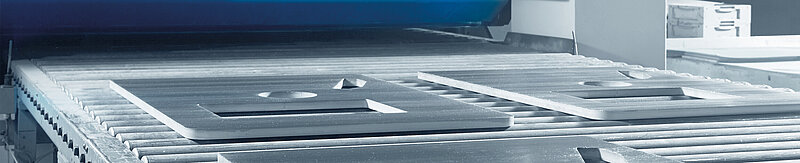
Multi-roller levelling machines represent the current state of the art. During roller levelling, a sheet of metal undergoes several successive alternating bends. From the inlet to the outlet, the levelling rollers are arranged in a staggered pattern. As a result, the sheet always passes between two opposing levelling rollers.
The alternating bends are very pronounced at the first levelling rollers. They become progressively weaker towards the exit. The progression of the bends thus resembles a decaying sine wave. The elastic-plastic alternating bends and a steadily decreasing degree of deformation result in a flat and, above all, stress-free sheet metal component.
Precision with up to 13 rollers
As the number of levelling rollers increases, so does the number of alternating bends. As a general rule, the more alternating bends there are, the more precise the levelling result will be. At least five rollers are required to produce any effect at all. However, this only achieves a rough degree of flatness. A rule of thumb for levelling rollers also states: Thinner material generally requires more rollers than thicker material. To achieve precision in terms of tolerances, at least eleven to 13 rollers are used in precision levelling machines.
Servo-hydraulic levelling machines for higher demands
Where requirements are higher, sheet metal parts often need to be levelled several times. Servo-hydraulic precision levelling machines are designed for higher levelling demands. The use of modern sensor and control technology has continuously improved the performance of the machines. The levelling rollers are optimally supported and are positioned close together. An integrated levelling gap control system maintains a constant levelling gap throughout the entire levelling process, even with varying part cross-sections. Even difficult-to-process cut parts are thus made flat and virtually stress-free within just a few levelling passes.
Internal stresses released during cutting lead to component warping
When cutting using thermal cutting processes such as laser or plasma cutting, a great deal of heat is introduced into the material directly at the cutting beam. This creates a significant temperature gradient within the material, thereby generating stresses. The result is usually warping after the cut. Furthermore, the stress balance of the sheet metal plate is altered by the removal of the cut-outs. Internal stresses released in this way also lead to component warping. This cannot be ruled out even with cold cutting processes such as sawing or abrasive waterjet cutting.
Whilst conventional ferrous metals normally exhibit no changes in mechanical properties such as yield strength or dimensions, austenitic stainless steels tend to harden after repeated levelling. However, this effect is negligible in practice.