Cutting processes are constantly evolving

Metalworking dates back to the Bronze Age: this makes it all the more astonishing that its development is still ongoing today. On the contrary: a look at manufacturing technology reveals that competition is increasingly differentiated by the specific production processes employed. Technological progress is causing the number of processes to rise continuously. As a result, the degree of specialisation is constantly increasing.

As a quality partner for custom sheet metal cutting, Rostfrei Stahl Geisweid (RFSG) focuses on cutting processes. In addition to waterjet cutting, these are primarily laser and plasma cutting, as well as sawing.
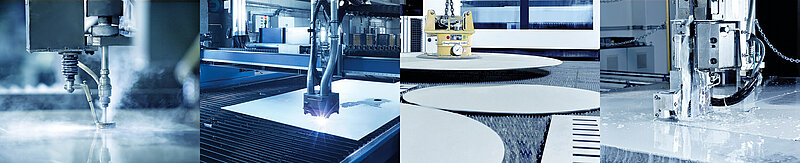
Waterjet cutting – gentle and precise machining

Modern businesses value the wide range of options offered by waterjet cutting. Practical experience shows that this process, in which metals are cut using water, pressure and fine-grained garnet sand, has largely replaced alternative cutting methods in many areas. This is hardly surprising, as waterjet cutting offers a wealth of different advantages. A key benefit is the precise machining of stainless steels without the introduction of heat.

In comparison, traditional methods such as drilling or milling are relatively labour-intensive. In particular, the use of cooling lubricants is required when working with austenitic stainless steels. RFSG – the experts in sheet metal cutting based in Netphen-Deuz (Siegen-Wittgenstein district) – utilise the capabilities of the abrasive waterjet cutting process for precise stainless steel cutting.

Abrasive waterjet cutting for hard and thick metals

High pressure, water and fine sand as an abrasive – these are the ‘ingredients’ required for abrasive waterjet cutting. It sounds simple, but it is a complex process: the cutting performance of the waterjet system is achieved through a finely balanced combination of a concentrated high-pressure water jet and the abrasive action of a fine-grained abrasive.

The speed and quality of the cut can be controlled by adjusting the pressure and the amount of particles in the water jet. Compared to other processes, water jet cutting offers many advantages:

  • Accuracy – in the tenths of a millimetre range
  • Impressive cut quality
  • Low surface roughness
  • Burr-free cutting
  • No need for post-processing
  • Achievement of the tightest tolerance limits

Expertise in precision abrasive waterjet cutting

When cutting sheet metal, RFSG utilises the technological advantages of the abrasive waterjet cutting process. Thanks to dual-head cutting systems, we can produce multiple identical parts simultaneously. This enables us to manufacture on cost-effective terms.

Process-related advantages mean that abrasive waterjet cutting has, in many cases, replaced mechanical machining. As a result, the high-precision cuts rarely require any reworking by the customer. Furthermore, because the cut is made without heat input, steels can be processed gently. Changes to the microstructure at the cut edge are ruled out. Thanks to our modern, efficient and energy-saving cutting systems, fewer climate-damaging CO2 emissions are produced.

Laser cutting – versatile and precise

Modern laser technologies offer the ability to produce cuts that are largely free of oxidation. Precise cutting of stainless steel sheets of varying thicknesses – that is what modern laser cutting is all about. In practice, laser cutting is most commonly used for materials up to 20 millimetres thick. The operating principle of laser cutting utilises the physical properties of focused light. The very high power density achieved by focusing the beam provides ideal conditions for precisely cutting stainless steel sheets. What sounds simple is actually a complex process.

When laser-cutting stainless steel sheets, the light beams oscillate in unison. In technical circles, this is referred to as monochromatic coherent light waves. The interaction with the parallel propagation of the light waves creates a focused beam of light. This beam has a high power density, making laser technology the ideal cutting tool for stainless steel sheets. The actual laser cut is made when the precision light beam strikes the workpiece, melting or partially vaporising the material. The molten metal is then blown out of the cut with an inert gas. Only a narrow area at the edge of the cut is thermally affected.

Laser cutting – clean cuts at high speed

The actual cutting process involves melting or vaporising the material. Along the cutting line, the concentrated beams of light strike the stainless steel sheet. The area heats up intensely. The process takes place at high speed. A cut is formed as the molten material is blown away. This marks the start of the cutting process.

Precise cutting results. Clean cut edges. The advantages of laser cutting are easy to list. Added to this is a high processing speed. Thanks to the precision typical of the process, laser cutting enables the machining of complex contours. Post-processing is generally not required.

Plasma cutting – a classic among cutting processes

Cutting stainless steel using plasma technology is one of the most effective methods for cutting metal sheets. Plasma refers to a gas that is electrically conductive. The cut is made using a thermal melting process. At temperatures of around 30,000 degrees Celsius, the stainless steel melts. The plasma jet ensures that the material melts precisely within the kerf. To achieve a clean cut, the molten material is simultaneously blown out of the kerf under high pressure using an inert gas – i.e. a gas that does not chemically react with the cut.

Good cut quality. Minimal bevels. Further advantages of plasma cutting include the high working speed and the ability to achieve cutting thicknesses of up to 150 millimetres. In combination with the use of inert gases, clean cut surfaces are produced. Burrs or slag deposits occur only rarely. It is important to note that, despite the intense heat generated during plasma production, the stainless steel barely heats up.

Sawing – a challenging cutting process

Straight cut edges. High precision. No heat input. Minimal reworking. Sawing metals offers many advantages. Nevertheless, sawing remains a challenge for many companies to this day. Against this backdrop, it is not surprising that RFSG relies on the performance of its own block band saw. The machine enables the processing of stainless steel sheets with dimensions of up to 6,300 x 3,000 x 150 millimetres.

Any Questions?

We are here to help

Contact

Fields
Message
Privacy Policy
captcha
Send