Stainless Steel – Versatile Material Properties

Stainless steel is robust, durable, and highly resistant to weathering. It also offers good corrosion resistance and high temperature resistance. Furthermore, stainless steel is suitable for environments where hygiene is critical. In everyday language, the term “stainless steel” is often used as a synonym for non-rusting steels. This is incorrect. Even stainless steel sheets can rust. According to the EN 10020 standard, the term “stainless steel” refers to alloyed and unalloyed steels with a high degree of purity. Various steel additives—so-called alloying elements—ensure that stainless steel sheets are characterized by special properties. If stainless steel sheets have a high proportion of alloying elements, they are referred to as high-alloy corrosion-resistant stainless steels (EN 10088).

Alloying elements Chemical symbol Material property
Chromium Cr Hardness, corrosion resistance
Cobalt Co Wear resistance
Manganese Mn Wear resistance
Molybdenum Mo Tensile strength
Niobium Nb Elasticity
Vanadium V Elasticity
Tungsten W Heat resistance

Precise laser-cut stainless steel blanks

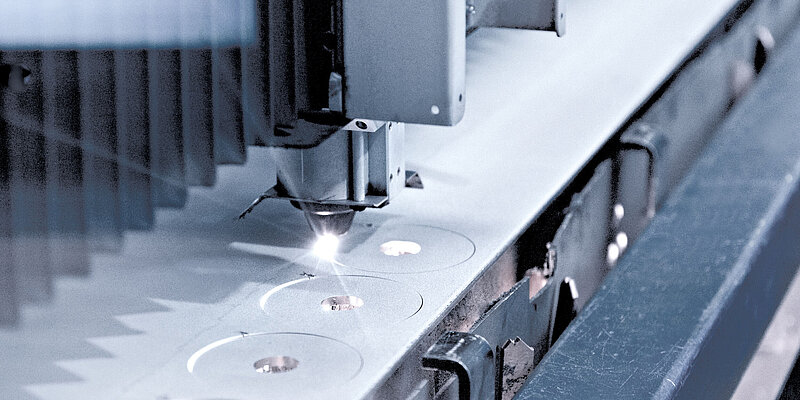
The remarkable material properties of high-alloy stainless steel sheets make the cutting process a job for specialists. The necessary expertise and a thorough understanding of the processes are essential for achieving precise results. Experience has shown that laser cutting technology is particularly well-suited for precise cuts in materials up to 20 millimeters thick and offers a wide range of advantages.

Laser cutting is a method that allows these materials—which are generally difficult to machine—to be cut without causing tool wear. This is because the laser cuts the stainless steel sheet without making contact with it during the cutting process. The cutting process itself is characterized by high processing speed and precision. The cut edges produced by laser cutting are clean. Post-processing steps such as deburring are generally not required for thinner sheet thicknesses. During laser cutting, heat is introduced into the stainless steel sheet only locally—along the cut edge. Consequently, the thermal stress on the stainless steel sheet during laser cutting is minimal. The often-feared hardening of the heat-affected zone/edge zone does not occur in austenitic stainless steels. As a result, this means that laser cutting is a material-friendly process that also enables the creation of precise contours and complex shapes.

Overview of the Advantages of Laser Cutting Stainless Steel Sheets

  • Suitable for sheet thicknesses of up to 20 millimeters
  • High-precision cuts
  • High processing speed
  • Clean cut edges
  • Low-warpage process that minimizes material damage
  • No deburring required
  • Precise outlines and complex contours possible
  • Minimal thermal stress on the stainless steel sheet

Laser Cutting Technology

Thanks to its many advantages, laser cutting has truly revolutionized the cutting of stainless steel sheets. For about 30 years, CO₂ lasers were considered the gold standard for cutting stainless steel with precision, speed, and minimal heat input. But technological advancements continue to move forward in this field as well. High-performance fiber lasers have now replaced the good old CO₂  lasers. Modern laser cutting systems impress with an efficiency that is 30 to 40 percent higher than that of conventional CO₂  laser systems. Unlike CO₂  lasers, fiber lasers do not require gas to generate the beam.

How Laser Cutting Works

Concentrated beams of light provide ideal conditions for processing stainless steel sheets. In simple terms, laser cutting works as follows: The laser’s light waves generate a concentrated beam of light with high power density. Experts refer to these as monochromatic, coherent light waves that share the same wavelength and oscillate in unison. When these high-energy light waves strike a stainless steel sheet, the corresponding area of the sheet is heated very quickly and intensely. The material melts or vaporizes. The light beam penetrates the stainless steel. A cut is created by precisely blowing away the molten material. The laser cutting process has begun.

Advantages of Fiber Lasers for Cutting Compared to CO₂ Lasers

Gas consumption per meter of cut is also lower. Thanks to this, and to the reduced energy requirements resulting from higher efficiency, these systems are more resource-efficient. Cooling requirements are also significantly lower. Compared to CO₂ lasers, the maintenance intervals for a fiber laser are also significantly longer.

In addition to many other advantages, fiber lasers also deliver impressive results in laser cutting. Narrow kerfs are a testament to the performance of this modern generation of lasers. Furthermore, the systems are considered robust, and large-scale cutting systems can be implemented without the need for “re-cutting.”

Customers of RFSG (Rostfrei Stahl Geisweid) enjoy these benefits when it comes to laser cutting stainless steel. Thanks to state-of-the-art laser technologies, the Netphen-Deuz-based company (Siegen-Wittgenstein district) offers the option of oxidation-free laser cutting. The experts in custom cutting process stainless steel sheets with dimensions of up to 6,000 × 2,500 × 20 millimeters. RFSG’s in-house laser cutting system has a power output of up to 10 kW, making it one of the most powerful systems currently available on the market.

Any Questions?

We are here to help

Contact

Fields
Message
Privacy Policy
captcha
Send