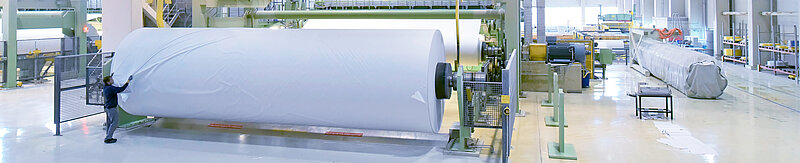
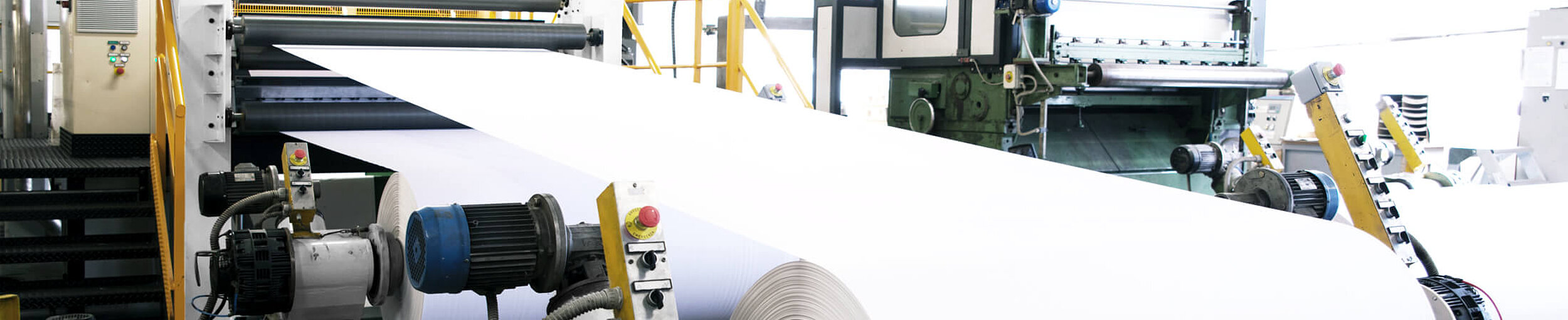
Forming. Pressing. Drying. The production of paper, cardboard or paperboard requires reliable processes and high-performance machinery. Paper machines vary in size, speed and the individual units they comprise. What is generally referred to as a ‘paper machine’ proves, on closer inspection, to be far more comprehensive: appropriately designed systems are not used solely for the production of paper.

Cellulose, hygiene and tissue papers, as well as all types of cardboard and paperboard, are also produced on these complex machines. Although sizes and designs vary, the operating principle is always similar: a so-called wire section is followed by a wire section. After the press section, the material passes through a drying section and is then rolled up.
Stainless steel – effective protection against corrosion, acid and heat

The performance of such machinery is impressive: modern paper machines for tissue or newsprint run at well over 2,000 metres per minute – with a working width of ten metres or more. To put this into perspective: this is equivalent to the size of three football pitches. Even without specialist knowledge, it is clear just how demanding the requirements placed on the material are.

Of particular note here is contact with media such as acidic foams. Especially in the wet end, production leads to undesirable deposits of substances that can have a negative impact on paper quality and machine efficiency. Although the use of acidic foams with pH values between 0 and 1 dissolves mineral deposits, this simultaneously increases the demands placed on the paper machine’s materials.

Request a consultation for the paper industry

Stainless steel 1.4404 – high chromium and molybdenum content

Against this background, stainless steel plays a particularly important role in the paper industry. In general, stainless steels not only possess good mechanical properties but are also resistant to wear and corrosion processes that are common in the pulp and paper industry. This applies in particular to the 1.4404 or 316L alloy.

This is an austenitic stainless steel of the AISI 316 type. The 1.4404 alloy is characterised by a high chromium and molybdenum content. Combined with a low carbon content, this results in the very good corrosion resistance typical of the alloy.

The alloy offers favourable material properties for use in the paper industry:

  • Low pitting corrosion
  • Resistance to chlorine-induced stress corrosion cracking
  • Resistance to intergranular corrosion
  • Heat resistance between 300 and 500 degrees Celsius

In addition, grade 1.4404 stainless steel offers good mechanical properties in terms of cold formability, cold heading behaviour and notch toughness. With regard to machining properties, it should be noted that 1.4404 stainless steel is not typically suitable for machining. The material is comparatively hard. Machining therefore results in high tool wear. Compromises must be made regarding cutting speed. However, grade 1.4404 stainless steel is well suited to modern cutting processes. Polishing presents few difficulties and weldability is assured. Laser welding is also possible.

Modern cutting processes for stainless steel

Leading companies in the paper industry have relied on bespoke components made from rust-, acid- and heat-resistant stainless steels for many years. As a quality partner for precision-cut stainless steel components, Rostfrei Stahl Geisweid (RFSG) has built a strong reputation in the industry over many years. And with good reason, because: professional sheet metal processing is one of the core competencies of Europe’s largest owner-managed stainless steel service centre. To achieve ideal cutting results, the company based in the Siegerland region relies on a modern machine park. Depending on requirements, plasma, waterjet and laser cutting processes, as well as a high-performance band saw, are used for cutting 1.4404 stainless steel.

In addition to the company’s own commitment to quality and expertise acquired over many years, RFSG is now focusing on a business area that is a matter of course for the Netphen-Deuz site: in the wake of the coronavirus pandemic and the war in Europe, the efficiency of its own high-bay warehouse is increasingly coming into focus. It is traditionally well-stocked and ensures that RFSG remains able to deliver even in times of crisis. In times like these, the forward-thinking approach of the Siegerland-based company is tantamount to an additional safety net for businesses across many sectors.

3,000 tonnes of certified stainless steel sheet metal

Companies in the paper industry rely on the services provided by RFSG. The combination of modern manufacturing processes, precise cutting results and reliable delivery ensures that RFSG can respond flexibly and quickly to customer requirements. Around 3,000 tonnes of certified stainless steel sheets made from rust-, acid- and heat-resistant grades ensure reliable delivery. Alongside the high-capacity high-bay warehouse, RFSG’s commitment to quality is another unique selling point.

To ensure optimal results, all processing steps are accompanied by continuous quality controls. Measures such as these contribute to the highest level of transparency in sheet metal processing and provide companies in the paper industry with deep insights into the company’s high manufacturing standards. Comprehensive documentation such as this not only provides complete proof of the high manufacturing quality of all sheet metal processing steps, but also forms the basis for RFSG’s certification in accordance with the DIN EN ISO 9001:2015 standard.

Enquire about stainless steel blanks for the paper industry

Any Questions?

We are here to help

Contact

Fields
Message
Privacy Policy
captcha
Send